What is a solar panel?Technological advancements in solar panels have always revolved around one core objective: reducing the levelized cost of electricity (LCOE).
Working Principle: Synergy Between Semiconductors and Electric Fields
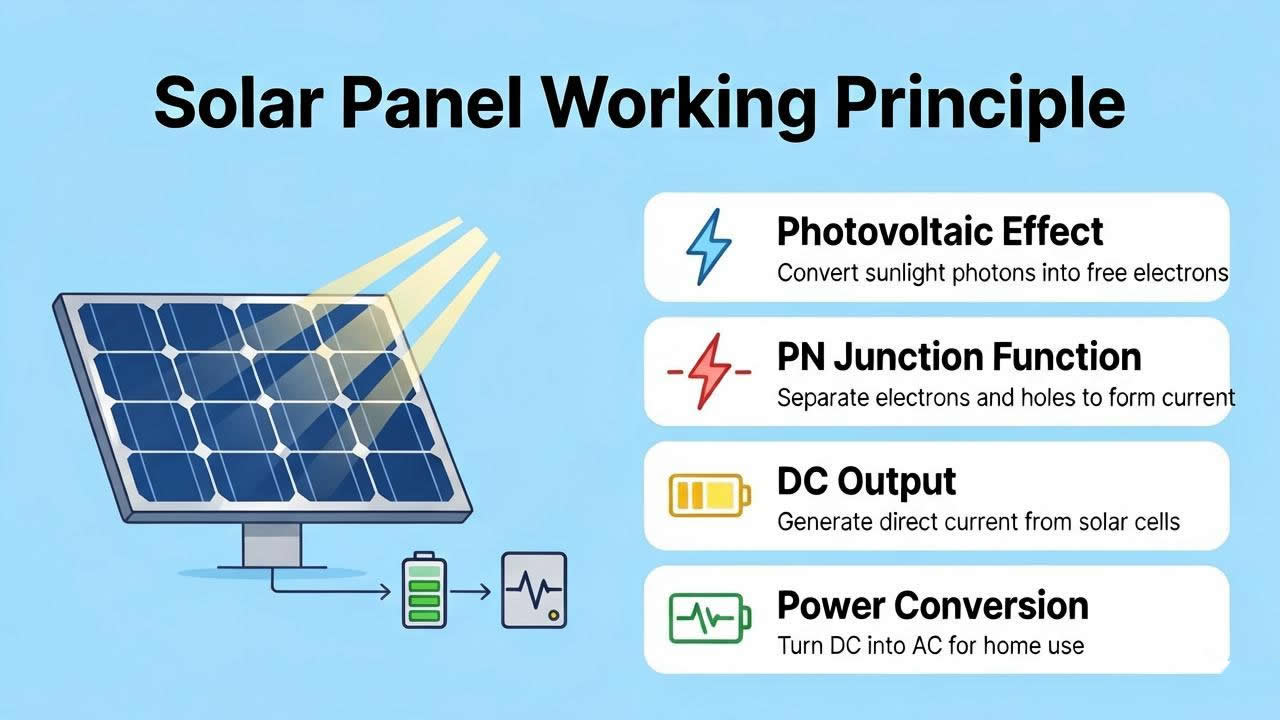
The core of a solar panel lies in its ability to convert light into electricity. The physical basis of this technology is the built-in electric field effect in semiconductors. When sunlight strikes the surface of a solar panel, the energy of the photons is absorbed by the semiconductor material. Photons with sufficient energy knock electrons out of their atomic orbits, creating free electrons and corresponding holes. Within the pre-fabricated p-n junction region inside the semiconductor, these free electrons are pushed in a specific direction by the built-in electric field, thereby generating a direct current (DC) output.
Energy loss during this process is very low. Under standard test conditions, a standard solar panel can directly convert approximately 20% to 22% of the incident light energy into electrical energy. A single solar panel typically consists of 60 or 72 solar cells connected in series, with an open-circuit voltage generally ranging from 30 to 50 volts. Actual power generation depends on light intensity, ambient temperature, and the panel’s installation angle. Rising temperatures reduce the output voltage, so good ventilation and heat dissipation are crucial for maintaining power generation efficiency.
Major Types of Solar Panels
| Type |
Key Feature |
Typical Efficiency |
| Monocrystalline Silicon |
Made from a single, continuous crystal structure. More efficient but often more expensive . |
Around 22% or higher |
| Polycrystalline Silicon |
Made from multiple silicon crystals melted together. Less efficient but cheaper to manufacture . |
Around 15-18% |
| Thin-Film |
Made by depositing very thin layers of semiconductor material onto glass or plastic. Flexible and lightweight, but generally less efficient . |
Around 19% for some types |
Physical Structure of Solar Panels
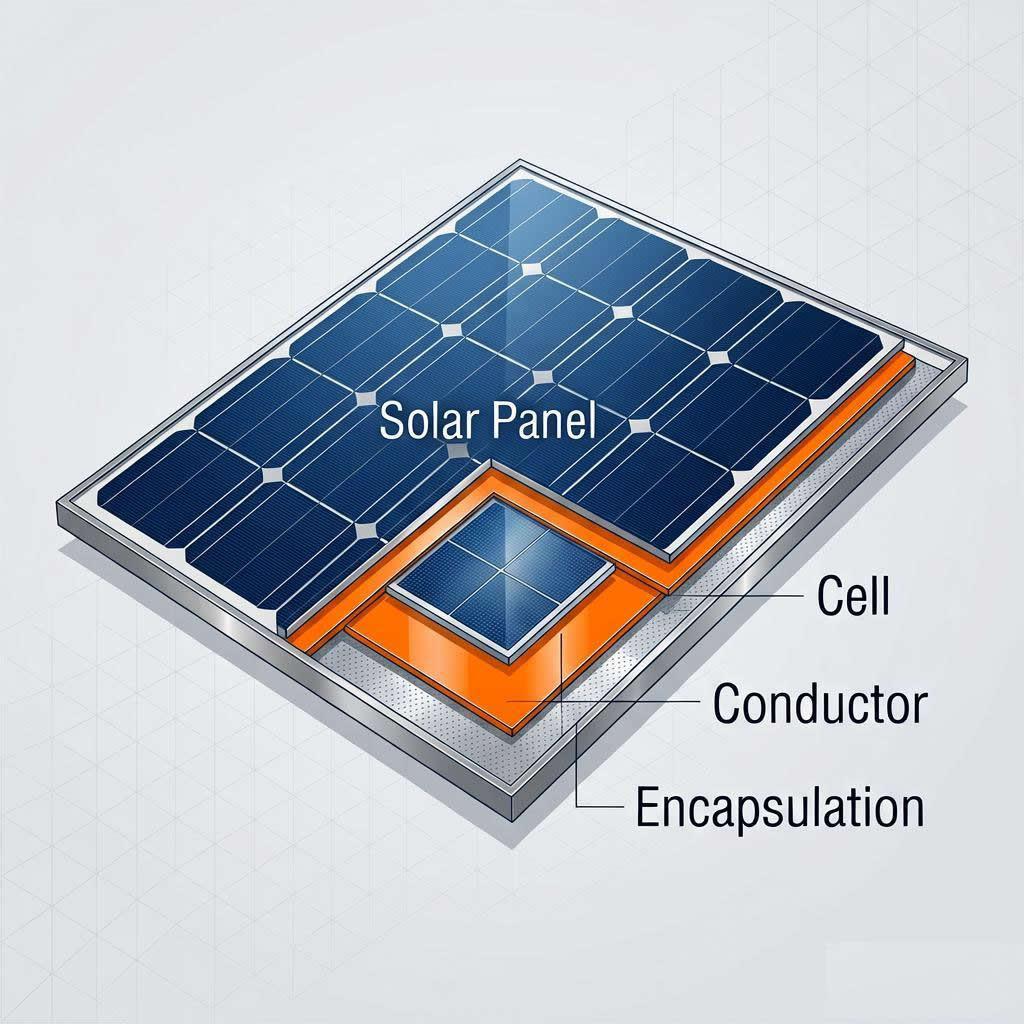
A complete solar panel is a product consisting of multiple layers of materials bonded together. Starting from the light-receiving side and moving downward, the layers are as follows: low-iron tempered glass, with a light transmittance exceeding 91%, which also provides impact resistance and self-cleaning properties; an EVA or POE adhesive film, which serves as the critical bonding layer, tightly bonding the glass, solar cells, and back sheet while providing electrical insulation. The cell layer is the core of power generation; its surface is printed with silver paste grid electrodes used to collect and conduct the photoelectric current. The back sheet is typically made of white fluorinated polymer material, providing a moisture barrier and insulation protection for the rear surface. The aluminum frame is bonded to the laminate using silicone, giving the solar panel sufficient mechanical strength to withstand wind pressure and snow loads. The junction box is installed in the center of the backsheet and contains a built-in bypass diode, which provides a current bypass path when solar cells are shaded, preventing damage from localized hot spots.
Key Considerations for Mounting System Selection
The selection of a mounting system directly impacts the safety and long-term reliability of solar panel power generation. Engineering decisions are primarily made based on the following factors:
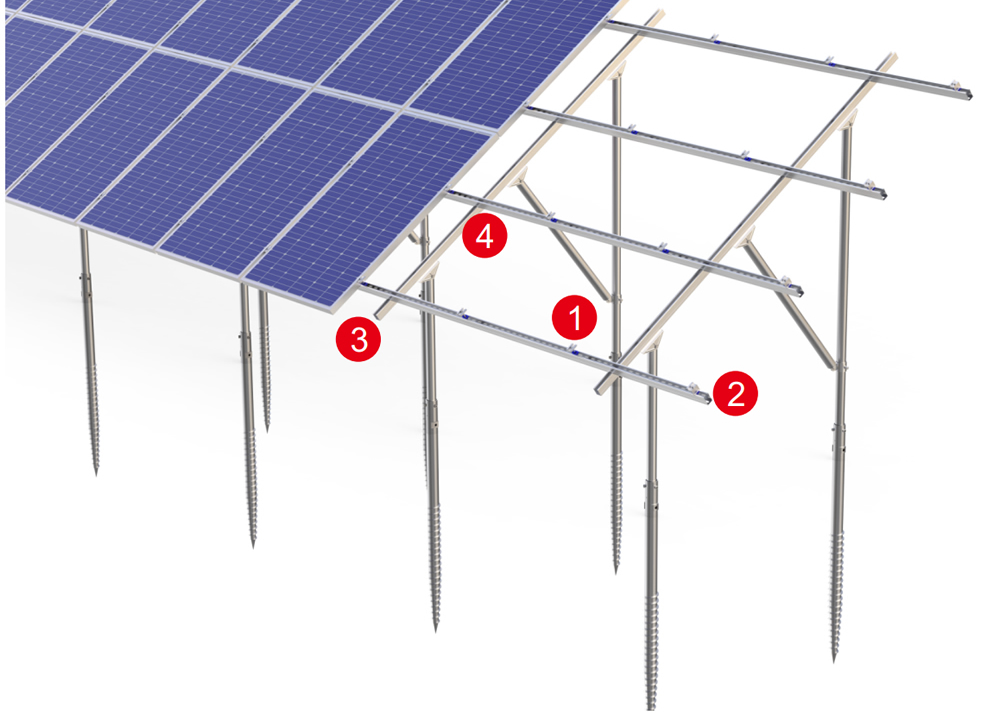
Site conditions are the primary factor. For flat roofs, ballast-type mounting systems are recommended, which use the weight of concrete blocks to resist wind loads without damaging the waterproofing layer. For color-coated steel sheet roofs, clamp-type mounting systems are commonly used, which interlock with the ribs of the roof panels for secure fixation. Large-scale ground-mounted power plants generally use pile foundations or precast foundations combined with support columns.
Climatic load parameters determine the design strength of the mounting system. It is necessary to collect data on the basic wind pressure, basic snow load, and seismic design intensity for the project site. The mounting structure must undergo rigorous structural analysis to ensure that the solar panels will not be blown off or crushed under extreme weather conditions occurring once every 50 years.
Adjustability is another important factor. Fixed mounting systems are set at the optimal annual tilt angle for the local area; they are simple to install and have the lowest maintenance costs. Horizontal single-axis tracking mounts allow solar panels to rotate around a horizontal axis; the sun-tracking angle can increase annual power generation by approximately 15% to 20%. Dual-axis tracking systems track the sun simultaneously along both the elevation and azimuth axes, offering the highest power generation gain; however, their mechanical structures and control systems are complex, making them suitable for areas with higher electricity prices or where land costs are a significant consideration.
Corrosion resistance requirements are directly linked to the installation environment. In coastal tidal flats or industrially polluted areas, steel with a hot-dip galvanized coating of at least 85 micrometers must be used, or aluminum alloy
solar mounting structures should be employed directly. Stainless steel fasteners are also essential.
From a Single Solar Panel to a Large-Scale Power Plant
The power output of a single solar panel currently ranges from 200 watts to 600 watts. However, when hundreds of thousands of solar panels are connected in series and parallel to form an array—and integrated with inverters, combiner boxes, step-up transformers, and monitoring systems—they constitute a complete photovoltaic power plant.
The DC-side voltage of large-scale power plants is typically elevated to 1,500 volts, which reduces line losses and minimizes cable usage. Each string consists of more than twenty solar panels connected in series; multiple strings are connected in parallel within a combiner box and then fed into a central inverter or string inverters. The inverters perform maximum power point tracking and convert DC to AC. The AC side is connected to the medium- or high-voltage grid via a step-up transformer. The power generation capacity of the entire system ranges from megawatts to gigawatts, and the land area required can reach several thousand mu. During the design phase, specialized software is used to perform shading simulations and power generation simulations to ensure that no shading occurs between rows of solar panels.
Conclusion
Higher efficiency, longer lifespan, lower manufacturing costs, and more precise tracking strategies for mounting systems—these factors collectively drive photovoltaic power generation to become one of the most economical sources of electricity globally. Whether involved in module manufacturing, power plant design, or operations and maintenance management, a deep understanding of the fundamental characteristics of solar panels is the starting point for making sound technical decisions.
Why Choose Yiteng
Yiteng has over a decade of experience in structural design and engineering delivery within the
solar mounting system sector. We offer a full range of products, from fixed mounts to intelligent tracking systems, with all solutions customized through structural analysis based on local wind, snow, and seismic loads. Choosing Yiteng mounting systems ensures that your solar panels will receive stable, reliable, and high-return support throughout their entire lifecycle.


