How Much Do Solar Roofs Cost?Solar roofs are primarily cost-effective if you prioritize aesthetics, are planning to replace your roof anyway, or if local regulations prohibit the installation of visible solar panels.
Straight Answer: How much does a solar roof cost? The total cost of installing a solar roof system typically ranges from 250,000 to 1.15 million RMB, depending on the roof area, brand, and location. Standard solar tiles cost approximately 1,600 to 2,000 yuan per square meter, while the Tesla Solar Roof has historically reached about 4,800 yuan per square meter (equivalent to 16 yuan per watt). By comparison, the average price of a traditional 5-kilowatt solar panel system is about 128,000 yuan (before subsidies).
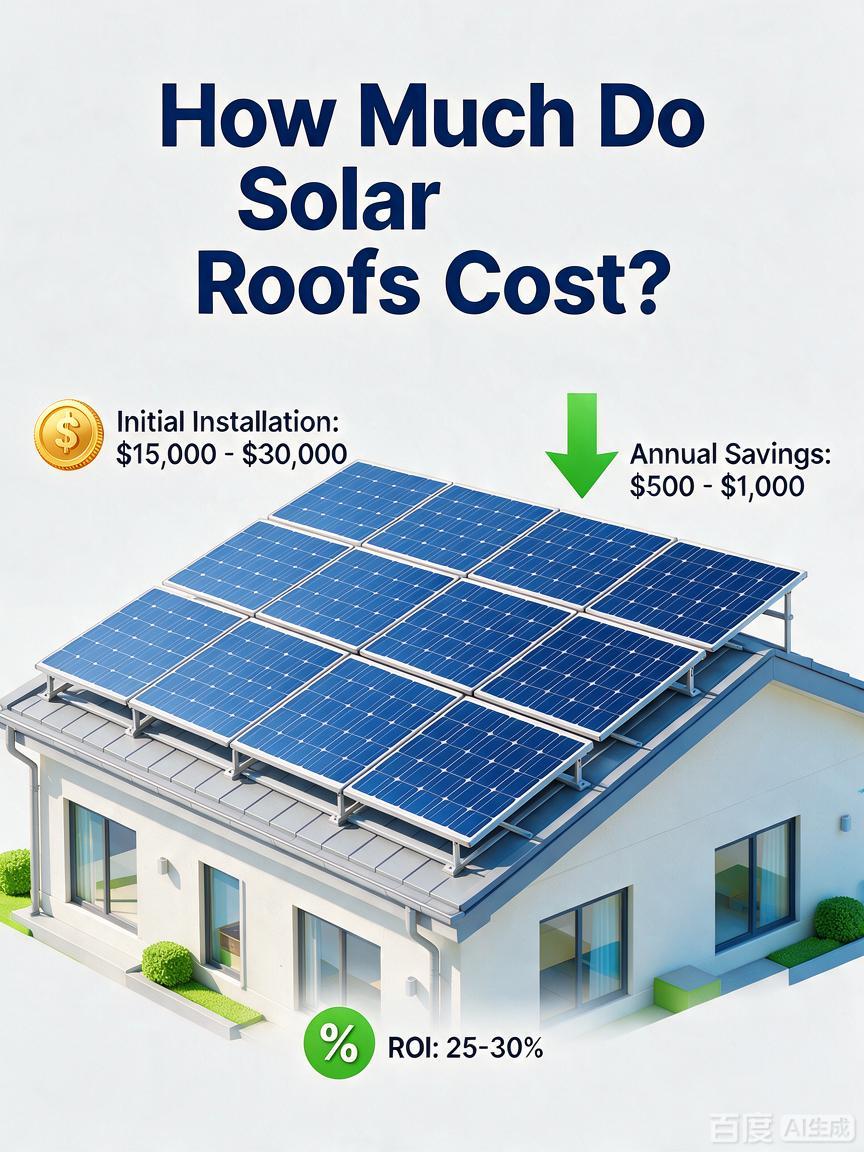
What is the average price of a solar roof?
Prices for solar roofs vary widely, depending largely on whether you choose standard solar tiles or a high-end integrated system like Tesla’s. Unlike traditional solar panels, solar roofs directly replace your existing roofing materials, so quotes typically bundle the roofing and power generation systems together.
Standard solar tiles cost approximately 1,600 to 2,000 yuan per square meter after installation, with a complete system for a standard residential roof typically costing around 250,000 yuan. Other market estimates range from 180,000 to 430,000 yuan, which works out to about 1,150 to 2,700 yuan per square meter for a roof of approximately 158 square meters.
The Tesla Solar Roof was once the most well-known product in this category, priced at approximately 4,800 yuan per square meter, or about 16 yuan per watt, with an average cost of 760,000 yuan for a standard system. Actual quotes vary widely, with some homeowners receiving quotes exceeding 1.45 million yuan. Tesla stopped accepting new orders on August 20, 2026, and this product is no longer available for purchase.
The cost per watt is particularly telling. Traditional solar panels cost an average of 2.5 to 3.5 yuan per watt after installation, while solar tiles can range from 3.8 to 7 yuan per watt. Tesla’s high-end system, at 16 yuan per watt, costs more than four times as much as traditional solar panels producing the same amount of electricity.
Does the price of a solar roof include a roof replacement? Yes, it does. Integrated solar roof products replace your existing roofing materials, so the quote includes the removal and disposal of the old roof, the installation of the new solar roof as a waterproofing layer, and all electrical work. However, this also means that regardless of whether you originally needed a roof replacement, you’ll be paying for a complete roof renovation.
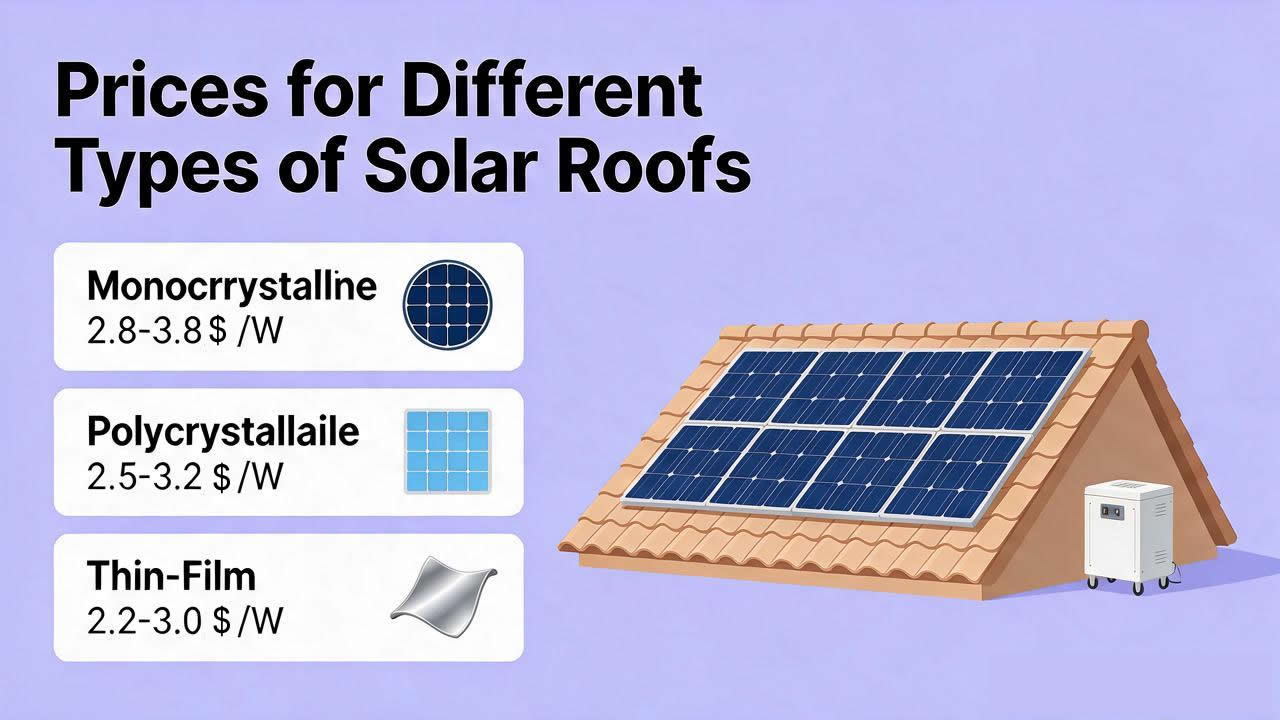
Prices for Different Types of Solar Roofs
Solar shingles are individual roofing units equipped with photovoltaic cells that are nailed or glued directly to the roof substrate, just like regular shingles. They are true building-integrated photovoltaic (BIPV) products. Prices range from 3.8 to 7 yuan per watt. GAF Energy’s Timberline Solar is considered the best value for money, costing approximately 3.8 to 5.5 yuan per tile. Budget-friendly options like SunTegra have a total cost of around 145,000 yuan for a small system.
Solar tiles function similarly to solar shingles but differ in appearance; they are typically larger and flatter, mimicking concrete or clay tiles. These products are less common than solar shingles and are generally more expensive, especially when installed on curved or irregular roofs. Prices typically range from 1,900 to 2,700 yuan per square meter, with complex installations costing even more.
Before it was discontinued, the Tesla Solar Roof was the most expensive and most visually striking option. At 4,800 yuan per square meter and 16 yuan per watt, it was more of a luxury architectural product than a cost-saving solution. A detailed comparison in California showed that a 7.2-kilowatt Tesla Solar Roof cost 830,000 yuan, while an equivalent asphalt roof paired with traditional solar panels cost only 210,000 to 310,000 yuan—a difference of approximately 580,000 yuan. Tesla cited cost and complexity as the reasons for discontinuing the product.
Traditional solar panels are not strictly speaking “solar roofs,” but they serve as the benchmark for pricing all solar roof systems. A typical residential system costs between 126,000 and 177,000 yuan before subsidies, or about 2.5 to 3.5 yuan per watt. If a new roof is also needed, add 58,000 to 145,000 yuan for asphalt shingles, bringing the total project cost to approximately 180,000 to 320,000 yuan—still significantly cheaper than most solar roofs.
What factors affect the price of a solar roof?
Roof area and complexity. The larger the roof, the more materials are required. Complex roofs with dormers, gutters, ridges, and obstructions result in both material waste and increased labor time. A simple gable roof will cost significantly less per square meter than a complex, multi-plane roof.
Roof shape and slope. Steep roofs require more safety equipment and result in slower installation speeds. Roofs facing multiple directions may require more solar tiles to achieve the same power output, or may simply generate less power.
Brand and materials. High-end brands like Tesla command the highest prices. GAF Energy’s Timberline Solar is more affordable, and its direct-nailed installation system reduces labor costs. Special substrates, such as slate, can increase installation costs by 15% to 25% because they require specialized mounting brackets and have a higher breakage rate.
Generation Capacity. Solar roofs are typically priced based on the number of active solar tiles installed. Systems that cover 100% of electricity consumption are more expensive than those that provide partial offsets. However, solar tiles have lower power density than solar panels and typically operate at 10% to 20% efficiency, compared to 15% to 22% for solar panels. Therefore, you may need more roof area to achieve your target power generation.
Labor and Installation. Installing a solar roof requires expertise in both roofing and electrical work. Labor intensity is typically 2.5 to 3 times that of traditional solar panels. In many markets, the limited number of installers further drives up prices.
Removal of the Old Roof. Integrated solar roofs require the removal of the existing roof, which adds to hauling costs and labor expenses. With solar panels, this cost can be avoided if the roof is in good condition.
Local Market and State Policies. Labor rates, permit costs, and grid connection requirements vary significantly by region. States with high electricity rates and generous subsidies can partially offset higher installation costs.
Comparison of Solar Roofs and Traditional Solar Panels
Comparison Item Solar Roof (Tiles) Traditional Solar Panels
Initial Cost 3.8 to 7 yuan per watt, higher for premium models 2.5 to 3.5 yuan per watt
Appearance Seamless, blends into the roof surface Visible, mounted above the roof
Power Generation Efficiency 10% to 20%; heat buildup reduces output 15% to 22%; airflow helps cool the panels
Lifespan 25 to 30 years; limited real-world data 25 to 30+ years; ample data available
Maintenance and Repair Repairs may require accessing the roof Module-level maintenance; easier to perform
Payback Period 15 to 20+ years 6 to 10 years, depending on the state and subsidies
Solar roofs win on aesthetics, while solar panels win on cost-effectiveness. The difference is significant enough that solar roofs are only cost-effective in a few scenarios: if you’re already planning to replace your roof, if your homeowners’ association doesn’t allow visible solar panels, or if you’re personally willing to pay the premium for the aesthetic appeal.
How to Calculate the Cost of Your Solar Roof
Step 1: Estimate your household’s annual electricity consumption. Dig out your electricity bills from the past 12 months. The average household uses about 10,500 to 11,000 kilowatt-hours (kWh) per year, but this varies significantly depending on your region and the size of your home.
Step 2: Calculate the required system capacity. Divide your annual electricity consumption by the local power generation ratio (typically 1,200 to 1,600 kWh per kilowatt). If you use 11,000 kWh per year and use a generation ratio of 1,400, you’ll need approximately 7.9 kilowatts.
Step 3: Estimate the cost per watt or per square meter. For traditional solar panels, multiply the kilowatt capacity by the local price per watt. For solar roof tiles, multiply the roof area in square meters by 1,600 to 2,000 yuan; prices are higher for premium brands.
Step 4: Add labor, the inverter, and the battery. Quotes per watt or per square meter typically include labor, and the inverter is usually included as well. Installing a storage battery adds 58,000 to 110,000 yuan—or even more—depending on capacity.
Step 5: Subtract available subsidies.
Solar Roof Subsidies and Tax Credits
Federal Tax Credit: The credit for new installations has expired. The 30% Residential Clean Energy Credit (Section 25D) has expired for solar expenses incurred after December 31, 2025. If your system was put into service on or before December 31, 2025, you may still claim the credit on Form 5695. For new installations in 2026, there will be no federal residential solar tax credit unless Congress passes new legislation. Commercial projects may still be eligible for support under Section 48E through 2027.
State subsidies vary widely. New York offers a 25% state credit, capped at $5,000. South Carolina offers 25%, capped at $3,500 per year, with a 10-year carryover. Massachusetts offers a 15% credit, capped at $1,000, plus a SMART subsidy based on electricity generation. New projects in Hawaii (effective July 2026) raise the state credit to 45% and establish direct rebates for low- and moderate-income households.
Net metering is critical to the economic viability of solar power. Under full retail net metering, excess electricity is credited at the retail rate, significantly accelerating the payback period. However, many states have shifted to net billing, which offers lower rates for exported electricity. California’s NEM 3.0 pays only about 5 to 8 cents per kilowatt-hour, making batteries essential. Massachusetts, New Jersey, New York, and Illinois still have strong net metering policies.
Financing and Loans. Solar loans typically have terms of 10 to 20 years, with interest rates ranging from about 4% to 8%. For a 145,000 loan at a 4% interest rate over 15 years, the monthly payment is approximately 1,070. Leasing and power purchase agreements require no upfront investment, but you won’t qualify for tax credits, and lifetime savings are generally lower.
How Long Does It Take for a Solar Roof to Pay for Itself?
Traditional solar panels pay for themselves in 6 to 10 years in states with favorable conditions. After the federal tax credit expired, the average payback period nationwide extended from about 8 years to 11 to 12 years—an increase of approximately 43%. In states with high electricity rates, such as California and Massachusetts, solar panels can still pay for themselves in 5 to 8 years when combined with strong net metering or self-consumption strategies.
Solar roofs have a much longer payback period. The cost per watt is 2 to 4 times that of solar panels, yet their power output is comparable or even slightly lower, often extending the payback period to 15 to 20 years or more. Many solar roof projects may not fully recoup their costs even within the warranty period, especially without the federal tax credit.
In terms of home equity, solar systems can indeed increase a home’s resale value, though the exact amount depends on the market. In neighborhoods with strict aesthetic standards, solar roofs may command a higher premium than visible solar panels.
Over a 25-year period, traditional solar panels in states with high electricity rates can yield net savings of 210,000 to 360,000 yuan. Solar roofs offer slimmer returns; their core value lies in the integration of aesthetics and functionality, rather than financial optimization.
Pros and Cons of Solar Roofs
Pros:
Better aesthetics. A solar roof looks just like a regular roof, with no visible panels, mounts, or wiring. This is important for the home’s appearance, homeowners’ association compliance, and the building’s structural integrity.
Integration of the roof and power generation system. If you’re planning to replace your roof anyway, a solar roof solves two problems at once—a new roof and a power generation system—in a single installation.
Durable. High-quality solar shingles come with a 25-year warranty and offer high wind and hail resistance ratings. GAF Energy’s Timberline Solar can withstand wind speeds of 130 miles per hour and meets Class 4 hail resistance standards.
More space-efficient on complex roofs. Solar shingles can be installed in roof areas where traditional solar panels either won’t fit or would look unsightly.
Disadvantages:
Significantly higher cost. For the same power output, a solar roof costs 2 to 4 times more per watt than traditional solar panels.
Lower efficiency. Without airflow beneath the solar shingles, temperatures rise higher; once temperatures exceed 25°C, output decreases by 0.3% to 0.5% for every 1°C increase.
Fewer installers. There are far fewer contractors qualified to install solar tiles than those who install traditional solar panels.
Manufacturer risk. Tesla’s discontinuation of the Solar Roof illustrates the risk of choosing a proprietary system. If a manufacturer exits the market, replacement parts and services may no longer be available.
Maintenance is more complex. If a solar tile fails, replacing it may require accessing the roof, unlike traditional solar panels, which can be removed and replaced directly from their mounting brackets.
Solar Roof Maintenance and Lifespan
Cleaning. Solar roofs are generally self-cleaning thanks to rain, but in areas with high dust or pollen levels, washing them once or twice a year can help maintain power generation efficiency. Take care during cleaning to avoid scratching the surface coating.
Repairs. If a single solar tile or shingle malfunctions, it usually requires the coordinated efforts of a roofer and an electrician. Troubleshooting leaks is more complicated than with traditional roofs because the power-generating layer and the waterproofing layer are integrated.
Warranty. High-quality products offer a 25-year warranty covering power generation and waterproofing. However, the warranty typically does not cover labor or issues caused by improper installation. It is important to keep installation documentation on file.
Battery Maintenance. If equipped with a storage battery, the battery generally comes with a 10-year warranty, after which its capacity will gradually decline. Batteries must be stored in a well-ventilated location at an appropriate temperature; extreme temperatures can affect their lifespan.
Lifespan. Solar roofs are designed to last 25 to 30 years, which is comparable to traditional roofs. However, because the product has a short history, actual lifespan data is not as comprehensive as that for traditional solar panels.
Is a solar roof worth it?
It’s suitable for new construction or for those who are due for a roof replacement. If you’re building a new home or your old roof has reached the end of its lifespan and must be replaced, a solar roof can combine these two expenses into one and offers a more aesthetically pleasing appearance. In these cases, the premium is relatively easy to justify.
They may not be suitable for those with roofs in good condition who are solely focused on minimizing costs. If your roof has another 15 years of life left and your primary goal is to save on electricity bills, installing traditional solar panels on your existing roof is almost always more cost-effective. It’s difficult to recoup the extra cost of a solar roof through the electricity it generates.
Frequently Asked Questions About Solar Roof Costs(FAQ)
How much does it cost for a 2,000-square-foot (approximately 186-square-meter) house? Assuming solar tiles cost between 1,600 and 2,000 yuan per square meter, and the roof area typically ranges from 100 to 140 square meters, the total cost is approximately 160,000 to 280,000 yuan. If you choose a high-end product like Tesla’s, the cost may exceed 600,000 yuan.
Is the Tesla Solar Roof worth buying? It is no longer available for purchase. Before production was discontinued, it cost more than four times as much as traditional solar panels, making it financially difficult to recoup the investment. It’s suitable for those who prioritize aesthetics and have a generous budget, but not for those looking to save money.
Can you walk on solar tiles? Yes, but it depends on the product. Most solar tiles are designed to withstand normal walking and maintenance, but frequent foot traffic may void the warranty. Installers typically mark safe walking areas on the roof.
Can a solar roof completely offset electricity bills? It can come close, but it’s difficult to fully offset them. Power generation depends on the roof’s orientation, area, local weather, and system capacity. Even if power generation is sufficient, many regions have fixed grid fees that cannot be offset. Adding a battery can increase the proportion of self-consumption, but it will raise costs.
How long do solar tiles last? Their design life is 25 to 30 years, comparable to that of a traditional roof. Inverters
Summary
How much does a solar roof cost? Depending on the area, brand, and region, the total price ranges from approximately 250,000 to 1.15 million yuan. High-end products, such as the discontinued Tesla Solar Roof, can cost more than 720,000 yuan. Solar tiles average 1,600 to 2,000 yuan per square meter, but the cost per watt is 2 to 4 times that of traditional solar panels.
For most homeowners, traditional solar panels installed as part of a standard roof replacement can generate the same amount of electricity for 200,000 to 450,000 yuan less.


